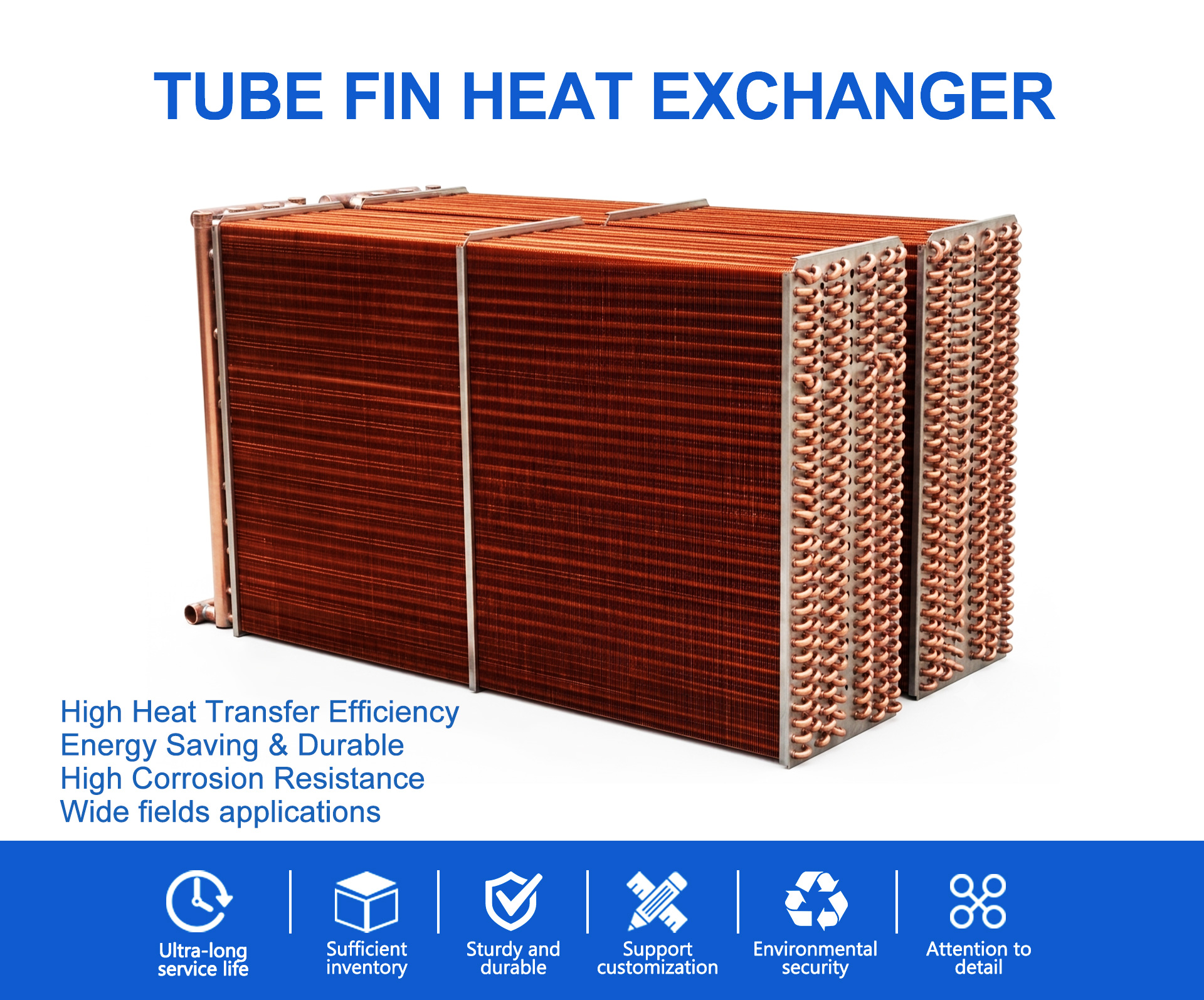
All-Copper Heat Transfer Coils for HVAC, Refrigeration and Industrial Applications
High Thermal Conductivity | Extended Heat Transfer Surface | Custom Coil Design
AIDEAR manufactures customized copper fin tube heat exchangers designed for efficient heat transfer between air and circulating fluids.
Combining copper tubes with copper fins, these heat exchangers offer excellent thermal conductivity and flexible coil configurations for commercial and industrial cooling, heating and refrigeration systems.
From compact equipment to customized industrial installations, AIDEAR provides application-oriented heat exchanger solutions based on your operating conditions, available space and thermal requirements.
Contact AIDEAR for a Custom Heat Exchanger Quote
01 | Efficient Heat Transfer Starts with Copper
Designed to Deliver Reliable Thermal Performance
Copper finned tube heat exchangers combine highly conductive copper materials with extended heat transfer surfaces to support effective thermal exchange.
In air-to-fluid heat transfer applications, copper fins increase the exposed surface area, helping transfer heat between the air stream and the fluid circulating through the tubes.
The all-copper tube-and-fin construction offers a practical option for applications where thermal conductivity, material compatibility and compact coil design are important considerations.
Key Product Features
Copper tubes and copper fins for effective heat conduction
Extended surface design for enhanced air-side heat transfer
Customizable tube diameter, fin spacing and coil dimensions
Flexible circuit arrangements for different operating conditions
Suitable for selected cooling, heating and refrigeration applications
OEM heat exchanger customization and engineering support
02 | Six Key Advantages of Copper Fin Tube Heat Exchangers
Engineered for Thermal Performance and Flexible Integration
01. Excellent Thermal Conductivity
Copper offers high thermal conductivity, allowing heat to move effectively through the tubes and fins. This makes copper a valuable material for heat transfer components in cooling and heating equipment.
02. Extended Heat Transfer Surface
Copper fins significantly increase the surface area exposed to the airflow compared with bare tubes. Proper fin design helps improve air-side heat transfer while accounting for airflow resistance.
03. All-Copper Tube and Fin Construction
Using copper for both the tubes and fins avoids the dissimilar-metal interface found in conventional copper-tube and aluminum-fin coils. This can be an advantage when evaluating material compatibility and corrosion risks.
04. Customizable Coil Structure
Tube arrangement, fin geometry, coil dimensions and fluid circuit design can be adjusted according to the operating conditions and installation requirements.
05. Compact Equipment Integration
Finned-tube technology allows a substantial heat transfer surface to be incorporated into a space-efficient coil assembly. The final size is determined by the required thermal duty and design conditions.
06. Flexible Industrial Applications
Copper fin tube heat exchangers can be designed for cooling, heating, condensation or evaporation duties, depending on the working fluid, operating temperatures and equipment configuration.
03 | How Does a Copper Fin Tube Heat Exchanger Work?
Understanding the Heat Transfer Process
A copper fin tube heat exchanger transfers thermal energy between the fluid flowing through the tubes and the air passing across the external fin surfaces.
The direction of heat transfer depends on the relative temperatures of the two media.
Step 1 — Fluid Enters the Copper Tubes
The working fluid enters the heat exchanger through the designed inlet connection and flows through the internal tube circuits.
Depending on the application, the fluid may be water, a suitable glycol solution, refrigerant or another compatible heat transfer medium.
Step 2 — Heat Transfers Through the Tube Walls
Thermal energy passes through the copper tube walls from the warmer medium toward the cooler medium.
Copper's high thermal conductivity helps reduce resistance to heat conduction through the metal.
Step 3 — Copper Fins Extend the Heat Transfer Area
The copper fins provide additional surface area for exchanging heat with the surrounding air.
The fin arrangement and tube-to-fin thermal contact influence the overall heat transfer performance.
Step 4 — Air Passes Across the Fin Surfaces
Air moves through the finned coil by natural or forced convection, depending on the system design.
Heat is transferred between the air and the fin surfaces, allowing the system to perform its intended cooling or heating function.
Step 5 — Fluid Exits the Heat Exchanger
After exchanging heat with the airflow, the fluid leaves the coil through the outlet connection and continues through the connected system.
Engineering Note: Actual heat transfer capacity depends on fluid properties, inlet conditions, airflow, coil geometry, circuit design and pressure-drop limitations.
04 | Main Components and Structural Design
Understanding the All-Copper Heat Exchanger Assembly
Copper Tubes
Copper tubes form the internal flow passages for the working fluid and provide a conductive pathway for thermal energy.
Tube diameter, wall thickness and internal structure are selected according to fluid requirements, operating pressure and thermal design.
Copper Fins
Copper fins provide an extended external heat transfer surface.
Fin thickness, shape and spacing are engineering variables that affect heat transfer, airflow resistance, fouling tendency and mechanical strength.
Tube-to-Fin Connection
Effective thermal contact between the tubes and fins is important for reducing thermal contact resistance.
The connection method is selected according to the required coil structure and manufacturing design.
Return Bends and Headers
Return bends or headers connect the flow passages and establish the required fluid distribution.
Their configuration depends on the number of circuits, fluid flow characteristics and installation requirements.
Supporting Frame
The coil frame provides mechanical support and helps the heat exchanger fit into the intended equipment or installation.
Frame dimensions and material selection can be coordinated with the project requirements.
05 | Copper Fin Tube Heat Exchanger Applications
Flexible Solutions for Cooling, Heating and Refrigeration
HVAC Cooling and Heating Systems
Copper finned coils can be used in suitable air-handling equipment, heating units and air-conditioning systems to transfer heat between air and circulating fluids.
Commercial Refrigeration
Copper tube and fin heat exchangers can be designed for appropriate refrigeration applications, including air-cooled condenser and evaporator arrangements.
Industrial Process Cooling
Industrial machinery and process systems may use finned coils to reject heat from water, glycol or other compatible circulating fluids.
Air Heating Equipment
Hot-water or other suitable heating coils can transfer thermal energy from a heated working fluid to an airflow for ventilation and industrial heating purposes.
Heat Recovery Systems
Copper fin tube heat exchangers can support selected heat recovery applications by transferring otherwise unused thermal energy to a secondary air or fluid stream.
Customized OEM Equipment
Copper finned coils can be integrated into specialized cooling and heating equipment where dimensions, fluid connections and thermal requirements must be matched to an existing system.
Each application requires a dedicated review of operating pressure, temperature, fluid compatibility and thermal performance.
06 | Copper Fins vs. Aluminum Fins
How Material Selection Affects Heat Exchanger Design
Both copper and aluminum are widely used as fin materials in heat transfer equipment.
The preferred material depends on thermal requirements, environmental exposure, equipment weight, manufacturing cost and maintenance considerations.
Copper Fins
Higher thermal conductivity than aluminum
Greater material density and weight
Compatible with all-copper tube-and-fin construction
Suitable for applications where copper material properties are preferred
Generally higher material cost
Aluminum Fins
Good thermal conductivity for common HVAC applications
Lower density and lighter weight
Generally more economical
Widely used in conventional finned-tube heat exchangers
Requires appropriate corrosion protection where environmental conditions demand it
Which Material Should You Choose?
Copper fins are worth considering when thermal conductivity and material compatibility are important design priorities.
Aluminum fins remain a practical choice for many applications where weight, cost and suitable thermal performance must be balanced.
Copper fins do not automatically guarantee higher overall heat exchanger efficiency or longer service life. Coil geometry, operating conditions, air-side heat transfer, fouling and corrosion exposure must also be considered.
AIDEAR can help evaluate suitable heat exchanger configurations based on your project requirements.
07 | Customized Heat Exchanger Design
Built Around Your Equipment and Operating Conditions
Different applications require different combinations of heat transfer area, airflow resistance, fluid pressure drop and mechanical dimensions.
AIDEAR provides customized heat exchanger design services to support the technical requirements of individual projects.
Tube Configuration
Copper tube diameter, wall thickness and suitable internal structures can be evaluated according to thermal duty and working pressure.
Fin Geometry
Copper fin spacing, thickness and surface geometry can be selected according to airflow conditions and heat transfer requirements.
Coil Dimensions
Coil length, height, depth and number of tube rows can be designed to suit available installation space.
Circuit Arrangement
Fluid passages and connections can be configured according to flow rate, refrigerant distribution where applicable, and pressure-drop limitations.
Connection Design
Inlet and outlet connections can be coordinated with the piping arrangement and system requirements.
Structural Configuration
Frame design, coil mounting and assembly details can be adapted to suit the intended equipment.
OEM and Application-Based Customization
AIDEAR works with equipment manufacturers, engineering companies and industrial customers to develop heat exchanger solutions for their cooling and heating projects.
08 | Technical Specifications and Selection Options
Product Specifications Based on Project Requirements
| Parameter | Configuration / Selection |
| Product Type | Copper Fin Tube Heat Exchanger |
| Tube Material | Copper |
| Fin Material | Copper |
| Heat Transfer Method | Indirect Air-to-Fluid Heat Exchange |
| Tube Diameter | According to Design Requirements |
| Tube Wall Thickness | Selected for Operating Conditions |
| Fin Geometry | Application-Dependent Design |
| Fin Spacing | Customizable |
| Coil Dimensions | Customized |
| Tube Rows | According to Thermal Design |
| Fluid Circuit | Application-Specific |
| Connection Arrangement | Customized |
| Working Fluid | Subject to Material and System Compatibility |
| Design Pressure | According to Approved Design |
| Operating Temperature | According to Material and Application Limits |
| Main Applications | HVAC, Refrigeration, Industrial Cooling and Heating |
Important: The applicable pressure, temperature range and heat transfer capacity must be confirmed for each heat exchanger design. They are not universal ratings for all copper fin tube coils.
09 | Heat Exchanger Design and Manufacturing
From Technical Requirements to Finished Equipment
AIDEAR focuses on coordinating thermal design, material selection, manufacturing and quality inspection throughout the heat exchanger production process.
1. Technical Requirement Review
The project requirements are reviewed to establish the intended application, operating conditions, fluid properties and installation limitations.
2. Heat Exchanger Design
Tube arrangement, fin dimensions, coil structure and fluid circuitry are developed according to the thermal requirements.
3. Material Preparation
Copper tubes, copper fins and related components are prepared according to the approved design and manufacturing requirements.
4. Tube and Fin Processing
Tube forming, fin preparation and related manufacturing operations are carried out according to the selected construction method.
5. Coil Assembly
The copper tubes, fins and other components are assembled to form the designed heat exchanger structure.
6. Connection and Joint Processing
Tube connections, return bends and headers are completed using appropriate manufacturing methods for the selected coil construction.
7. Mechanical Inspection
The assembled heat exchanger is checked for relevant dimensional and construction requirements.
8. Pressure and Leakage Inspection
Applicable pressure and leakage inspections are performed according to the approved design and inspection requirements.
9. Final Inspection and Packaging
The completed product undergoes final checks and is prepared for suitable handling and shipment.
Manufacturing operations and inspection procedures may differ according to the product design.
10 | Why Choose AIDEAR?
Your Partner for Custom Heat Transfer Solutions
Established Heat Exchanger Manufacturer
Founded in 2016, Changzhou Aidear Refrigeration Technology Co., Ltd. specializes in heat exchangers and refrigeration equipment for commercial and industrial applications.
Engineering-Oriented Product Design
AIDEAR supports application-specific heat exchanger selection and customization based on cooling requirements, operating conditions and equipment design.
Broad Heat Exchange Product Range
Our product portfolio covers tube fin heat exchangers, microchannel heat exchangers, plate heat exchangers, dry coolers and other cooling equipment.
Flexible OEM Solutions
Heat exchanger dimensions, tube and fin configurations, fluid circuits and connection arrangements can be reviewed according to customer requirements.
Manufacturing and Quality Management
AIDEAR incorporates material selection, manufacturing control and appropriate inspection procedures into its product supply process.
International B2B Cooperation
We support customers seeking customized heat transfer components and industrial cooling solutions for projects in different markets.
AIDEAR — Be Your Idea!
11 | Frequently Asked Questions
Q1. What is a copper fin tube heat exchanger?
A copper fin tube heat exchanger uses copper tubes and copper fins to transfer heat between a fluid inside the tubes and air flowing across the fin surfaces. The fins increase the external heat transfer area.
Q2. What are the advantages of copper fins?
Copper fins provide excellent thermal conductivity and can be used with copper tubes to form an all-copper heat exchanger. Actual advantages depend on the operating environment, coil design and application requirements.
Q3. Is a copper fin tube heat exchanger better than a copper tube aluminum fin heat exchanger?
Neither construction is universally better. Copper fins offer higher thermal conductivity, while aluminum fins provide lower weight and generally lower material cost. Selection should consider overall performance, corrosion exposure, dimensions and project economics.
Q4. Can copper fin tube heat exchangers be customized?
Yes. AIDEAR supports customization of coil dimensions, fin spacing, tube configurations, fluid circuits and connection arrangements according to project requirements.
Q5. Can copper fin tube heat exchangers be used for both heating and cooling?
Yes. A copper finned coil can transfer heat in either direction. The specific equipment design, working fluid and operating conditions determine whether it is suitable for heating, cooling, condensation or evaporation.
Q6. Are copper fin heat exchangers suitable for corrosive environments?
Copper offers useful corrosion resistance in many environments, but it is not immune to corrosion. Suitability depends on the surrounding atmosphere, chemical exposure, moisture, operating temperature and other materials in the assembly. Additional protective measures may be necessary.
Q7. What determines the heat transfer capacity?
Heat transfer capacity depends on coil dimensions, tube and fin geometry, fluid type, fluid flow rate, airflow, temperature differences and other design conditions.
Q8. How do I select the correct copper fin tube heat exchanger?
Selection should begin with the required thermal duty, air-side conditions, fluid properties, operating temperatures, pressure limits and available installation space.
Q9. What information is needed for a custom quotation?
Customers are encouraged to provide the required heating or cooling capacity, fluid type, inlet and outlet temperatures, fluid flow rate, airflow conditions, permitted pressure drops, preferred dimensions and connection requirements.
12 | Request Your Custom Copper Fin Tube Heat Exchanger
Engineered for Your Application. Designed Around Your Requirements.
Looking for a copper fin tube heat exchanger for your HVAC system, refrigeration equipment or industrial cooling project?
AIDEAR provides customized heat exchanger solutions designed to match your technical requirements and installation conditions.
Whether you need a new heat exchanger design, a replacement coil or an OEM component, our team can discuss your operating conditions and suitable product configurations.
Tell Us About Your Project
For an effective technical evaluation, please provide:
Required cooling or heating capacity
Air inlet temperature and airflow conditions
Working fluid and operating conditions
Fluid inlet and outlet temperatures
Flow rate and pressure-drop requirements
Maximum operating pressure
Available installation dimensions
Required connection specifications
Application environment
Project-specific design requirements
CONTACT AIDEAR FOR A CUSTOM QUOTATION
All-Copper Heat Exchangers | OEM Customization | Engineering Support
Changzhou Aidear Refrigeration Technology Co., Ltd.
www.aidearheatexchanger.com
AIDEAR — Be Your Idea!

 English
 العربية
 Français
 Русский
 Español
 Português
 Deutsch
 italiano
 日本語
 한국어
 Nederlands
 ไทย
 Polski
 Türkçe
 አማርኛ
 ພາສາລາວ
 ភាសាខ្មែរ
 Bahasa Melayu
 ဗမာစာ
 தமிழ்
 Filipino
 Bahasa Indonesia
 magyar
 Română
 Čeština
 Монгол
 қазақ
 Српски
 हिन्दी
 فارسی
 Kiswahili
 Slovenčina
 Slovenščina
 Norsk
 Svenska
 українська
 Ελληνικά
 Suomi
 עברית
 Dansk
 اردو
 বাংলা
 Hrvatski
 Oʻzbekcha
 Български
 Hausa
 Кыргызча
 Тоҷикӣ
 తెలుగు
 Türkmençe
 isiZulu


